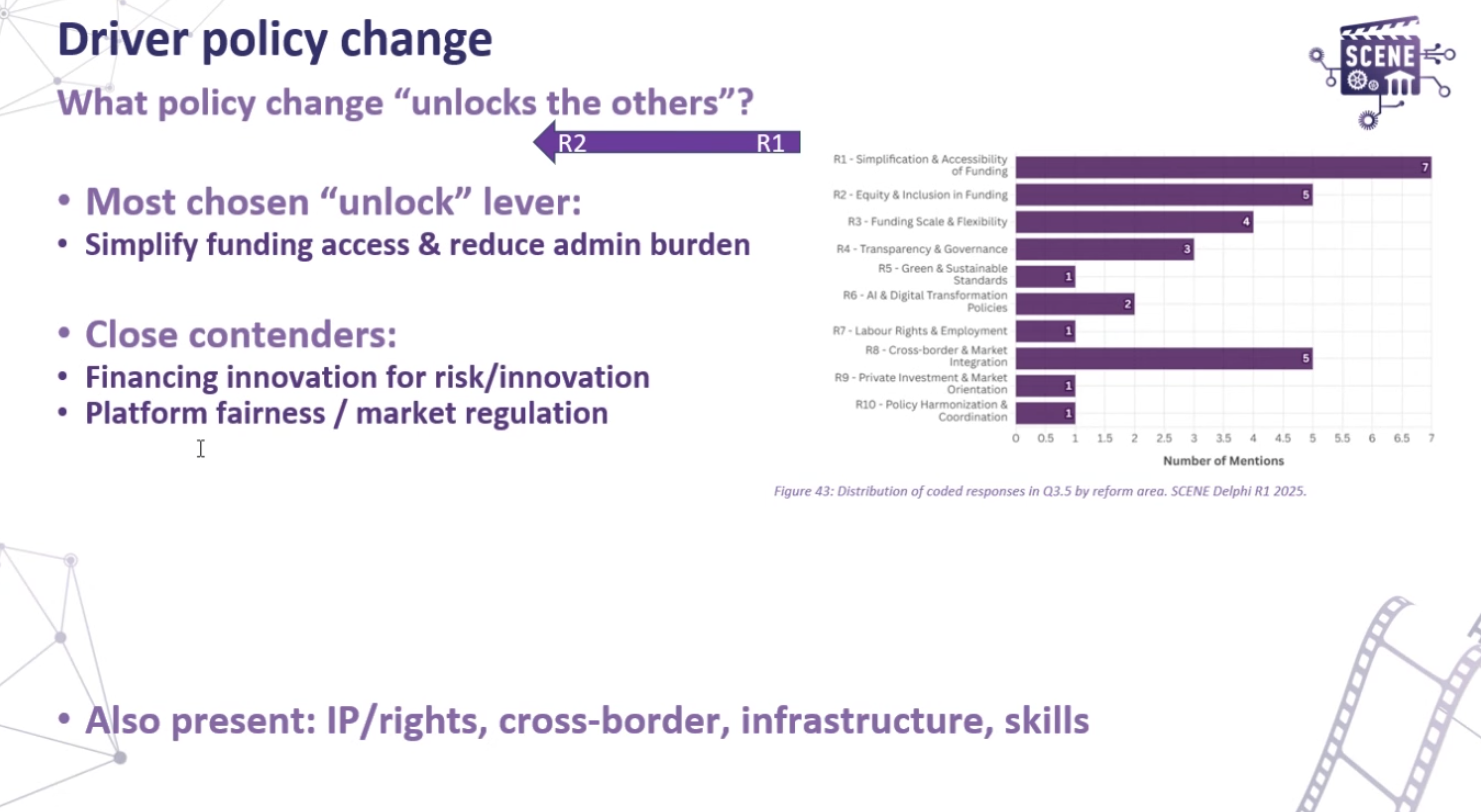
On 16 January 2026, the SCENE project organised an online Policy Workshop as part of Task 6.3, bringing together stakeholders from across the European filmmaking ecosystem to validate and prioritise emerging policy needs. The workshop aimed to translate evidence from SCENE’s expert study, a two-round Delphi exercise, into actionable policy priorities, coherent policy packages, and a realistic sequencing roadmap, directly supporting the project’s forthcoming policy brief and final public policy outputs.
The two-hour interactive session, organised by HYP with the support of the SCENE consortium, gathered 52 registrants, with 40 participants attending live and an additional 12 receiving the materials. Participants represented film commissions and public funds, filmmakers and producers, technology providers, research and innovation actors, and other support organisations, ensuring a balanced mix of policy, industry, and innovation perspectives.
The workshop combined a concise presentation of Delphi findings (Round 1 synthesis and early Round 2 signals), a structured online prioritisation questionnaire, and a collaborative Now / Next / Later sequencing exercise. This approach produced decision-oriented inputs for policy drafting, including ranked priorities, policy packages, concrete measures, and feasibility considerations.
For the 2026–2027 horizon, the strongest policy signals focused on funding usability—simpler access, faster and more transparent decisions—and skills and access at scale, combining training with affordable access mechanisms. AI policy baselines and cross-border interoperability were consistently framed as enabling conditions, while distribution and visibility were seen as essential but often longer-term or combined interventions.
Key Outcomes
Participants showed clear support for integrated policy approaches, particularly the packages Funding + Skills, Distribution & Visibility + Cross-border, and AI + Skills. Priority measures highlighted included lighter and more transparent funding pathways, shared facilities or voucher schemes for skills and access, harmonised cross-border procedures and interoperable templates, and stronger discoverability and audience development strategies.
On AI, there was a non-negotiable emphasis on authorship and credit, meaningful human creative control, and supporting principles of transparency, accountability, and consent.
Acknowledging constraints such as bureaucracy, market power, and uneven capacity across Europe, participants proposed a phased roadmap:
- NOW: skills development, faster funding processes, shared templates, baseline AI guidance, and standards
- NEXT: scaling interoperability and shared data and insights
- LATER: structural distribution measures and longer-term investment and governance frameworks
Policy Work
The outputs of the Policy Workshop are being integrated into the broader Task 6.3 evidence base (Round 1 and full Round 2 of the Delphi study) to support: (i) a ranked shortlist of policy priorities, (ii) two to three coherent policy packages, and (iii) refined policy wording accompanied by feasibility notes.
To ensure transparency and continued engagement, a short outcomes package – comprising presentation slides, the sequencing exercise output, and an anonymised summary of the interactive results – was circulated to all participants. The workshop outputs, together with all main findings of Task 6.3 (including the final policy brief and Deliverable D6.10), are being shared with representatives from EUFCN, who participated in both the Delphi study and the workshop, for further dissemination across policy-oriented networks within the European filmmaking industry.